Home › Concrete Slab Installation
Build on a solid foundation with professional concrete slab installation in Detroit, MI. We pour level, reinforced slabs for sheds, garages, additions, and patios. Our team handles site prep, forms, rebar, and finishing so your concrete slab is ready for framing or equipment.
Superior Concrete Detroit provides professional concrete slab throughout Detroit, MI, Michigan and the surrounding area. Our licensed, insured crew delivers safe, clean, on-time work with a free estimate before anything begins. Call (313) 986-4241 or request your free quote.
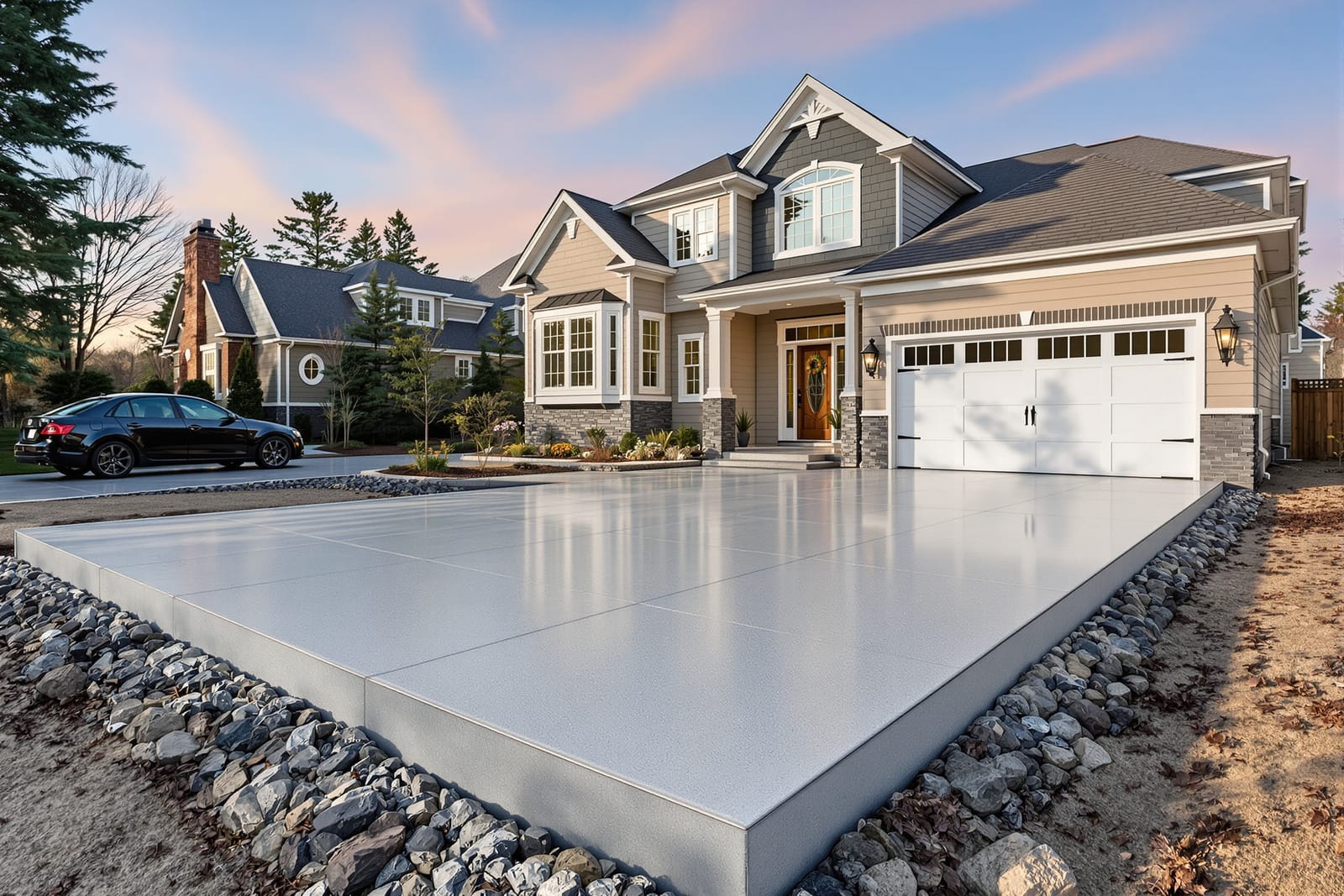
Concrete slab installation in Detroit done the right way
Superior Concrete Detroit installs concrete slabs for garages, pole barns, sheds, patios, basements, and interior floors throughout Detroit and the surrounding suburbs. We focus on getting the base, drainage, and reinforcing right so the slab lasts through Michigan freeze-thaw cycles instead of cracking and heaving in a few winters.
When you contact us, we start by asking how the slab will be used, what will sit on it, and what kind of access we have to the site. A slab that will carry a pickup truck or a loaded trailer needs more thickness and reinforcing than a patio or shed floor. We also ask about timing around Detroit weather. Outdoor slabs are best poured when night temperatures stay above freezing and rain is not in the forecast. For late fall or early spring work, we plan for blankets, accelerators, or temporary heat if needed so the concrete cures properly.
Our crews are familiar with typical Detroit soil conditions. Many city lots have a mix of fill and clay. We check for soft spots and organic material that must be removed before any gravel goes down. If we see drainage issues, such as water pooling near the future slab area, we address that in the plan so the slab is not sitting in water every spring thaw.
Site prep, base, and drainage for long lasting slabs
Most slab problems start below the concrete, not in it. Superior Concrete Detroit spends time on excavation and base work because Detroit's wet springs and winter frost will punish any shortcut.
We typically excavate 6 to 12 inches below the finished slab height, depending on use and soil. All topsoil, roots, and debris come out. On older Detroit properties, we often run into buried bricks, cinders, or rubble from past structures. Those pockets are removed and replaced with compactable material so the slab has uniform support.
After excavation, we place a compacted crushed stone base. In our area, a 4 to 6 inch base of 21AA or similar material is common. We compact in lifts so we are not just flattening the top. Proper compaction limits future settling and helps with drainage. If the slab is near a house foundation, we slope the base slightly away from the structure so surface water has somewhere to go.
For interior slabs or any slab where moisture coming up from the ground is a concern, we install a vapor barrier over the compacted stone. This plastic sheet helps reduce moisture transmission into basements, finished garages, or workshops. For exterior slabs that will see a lot of water, we discuss perimeter drainage or simple grading changes so meltwater and rain do not sit against the edges of the concrete.
Forming, thickness, and reinforcement options
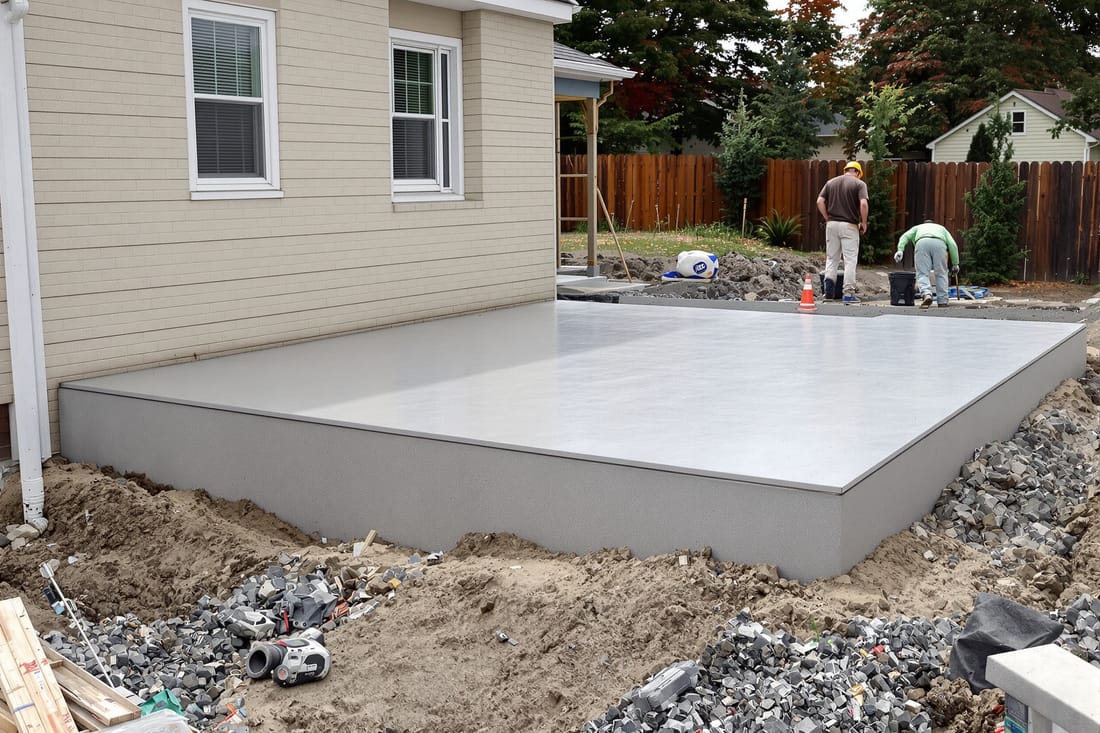
Once the base is ready, we set forms to define the exact shape, slope, and finished height of your slab. With Detroit snow and rain, we almost always pitch exterior slabs slightly so water runs off instead of pooling. Around houses and garages, we pay close attention to clearances at doors, siding, and steps so everything lines up when the forms come off.
Slab thickness and reinforcing depend on the load. For typical residential patios and walkways, 4 inches of concrete is standard. For garages, driveways, and pole barns where vehicles will park, we may recommend 5 to 6 inches. In areas where heavy trucks or trailers will sit, we can thicken the slab or add thickened edge beams.
Reinforcement options include wire mesh, rebar grids, or fiber reinforced concrete mixes. Wire mesh helps limit crack width but only works if it is kept in the middle of the slab, not left on the bottom. For heavier duty work, we often install #3 or #4 rebar at a specified spacing. Fibers in the mix can help control surface cracking during early curing. Superior Concrete Detroit explains the pros and cons of each so you can match the reinforcement to how you will actually use the slab, rather than paying for material that does not add value for your situation.
Concrete mix, placing, finishing, and curing
We specify mix designs that perform well in southeast Michigan. For most slabs we use a 4000 psi air entrained concrete mix. Air entrainment helps concrete withstand freeze-thaw cycles and deicing salts, both of which are realities in Detroit winters. For late season pours, we may use accelerators or warm water batches so the slab gains strength before cold nights.
On pour day, we schedule the ready mix truck so we have enough time to place and finish without rushing. We discharge the concrete into wheelbarrows, buggies, or directly into the forms depending on access. The crew spreads the concrete, strikes it off to grade, then bull floats to level the surface and bring up paste for finishing.
Finish type depends on use. Garage and driveway slabs typically get a broom finish for slip resistance during wet or icy conditions. Interior slabs that will receive vinyl, tile, or epoxy are finished smoother, within the flatness tolerances the flooring manufacturer calls for. Exterior patios can be broomed, lightly troweled, or given a decorative texture if requested.
Curing is not an afterthought. Proper curing dramatically increases strength and reduces cracking. We may apply a curing compound, keep the slab wet and covered, or use blankets to hold in moisture and heat. With Detroit's variable weather, we monitor the forecast and adjust. If a cold snap or heavy rain is coming, we protect the slab accordingly and instruct you on when it is safe to walk and drive on it.
Crack control, joints, and common slab issues
All concrete shrinks as it cures, and Michigan weather adds more stress. Superior Concrete Detroit manages this with planned joints and realistic expectations rather than promising a crack free slab, which no honest contractor can guarantee.
We install control joints at calculated spacings based on slab thickness and layout. These joints create weak planes so if the slab does crack, it is more likely to follow the joint line. Joints can be tooled into the fresh concrete or saw cut after the slab has gained enough strength. Timing is important. Cutting too early can ravel the edges, too late and the concrete may already have cracked where you do not want it.
We also look closely at transitions, such as where a new slab meets an existing driveway or garage floor. Detroit homes often have older sections of concrete that have already settled. We plan joint locations and, when appropriate, install dowels to tie slabs together while allowing some movement.
Common slab issues in our area include surface scaling from deicing salts, corner cracking at garage door openings, and edges chipping where snowplows or shovels catch. We address these risks before the pour by using air entrained mixes, adequate thickness, proper reinforcement around openings, and correct joint layout. After the pour, we give you clear instructions on when to start using the slab, how to keep heavy loads off it during early curing, and when to avoid salt exposure in the first winter.
Costs, timing, and what Detroit customers should decide upfront
Concrete slab pricing in Detroit is driven by access, thickness, reinforcement, site conditions, and finish type. A simple rear patio with easy wheelbarrow access and standard 4 inch broom finish will cost less per square foot than a 6 inch reinforced garage slab with limited access that requires pumping. Removing old concrete, dealing with poor soil, or adding drainage all affect the final price.
When Superior Concrete Detroit visits your site, we measure the area, check access for trucks or pumps, probe the soil, and look for any utility conflicts. Older Detroit neighborhoods may have shallow utilities or unknown lines in backyards. If private locates are needed, we build that into the schedule. Our written estimate breaks out the major components, such as base prep, concrete, reinforcement, and any demolition or hauling.
For exterior slabs, timing the work with Detroit weather matters. We recommend most projects between late spring and early fall. If you need a slab late in the season, we will be upfront about what it takes to do it correctly in cooler temperatures, including potential added costs for blankets, accelerators, or temporary heat. Rushing a slab in bad weather is a shortcut that usually shows up as scaling or cracking in the first couple of years.
Before hiring any contractor, decide what loads the slab must carry, whether you might enclose the area in the future, and what finish you want. Let us know if you plan to add a lift in the garage, heavy equipment, a hot tub, or thick tile or epoxy on top. These details help us design the slab correctly on day one so you are not paying twice later to fix or upgrade something that could have been done right the first time.